

 Download PDF
Market Overview
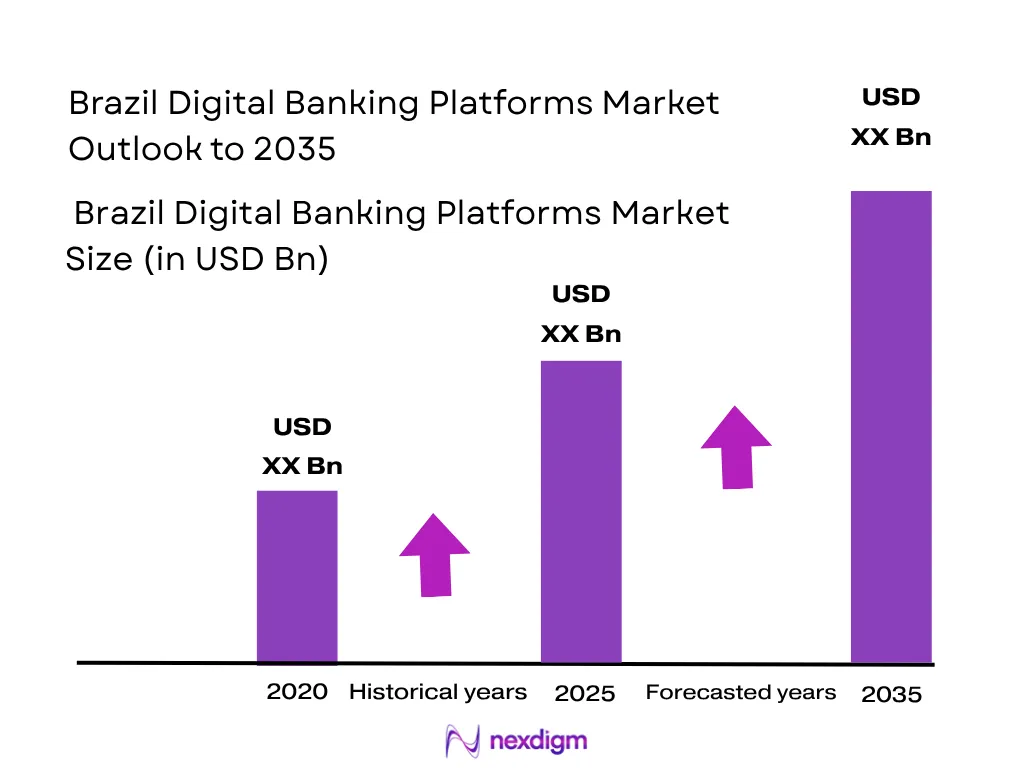
Brazil’s digital banking platforms market is strongly anchored in the country’s advanced financial infrastructure and rapid digital adoption. The Central Bank of Brazil reported Pix transactions reaching BRL 17 trillion in one period and increasing further to BRL 22 trillion in the following cycle, reflecting massive real-time payment usage. Additionally, Brazil’s IT services and financial software spending crossed USD 48 billion, with banking technology representing a major share. This expansion is driven by digital banks, Open Finance adoption, and increasing demand for API-based banking platforms across institutions.
The market is primarily dominated by major financial hubs such as São Paulo and Rio de Janeiro, supported by fintech ecosystems in Campinas and Curitiba. São Paulo leads due to its concentration of large banks, fintech startups, venture funding, and regulatory engagement with the Central Bank. Rio de Janeiro benefits from strong institutional banking presence, while emerging fintech clusters are gaining traction due to lower operational costs and government-backed innovation programs.
Market Segmentation
By Platform Type
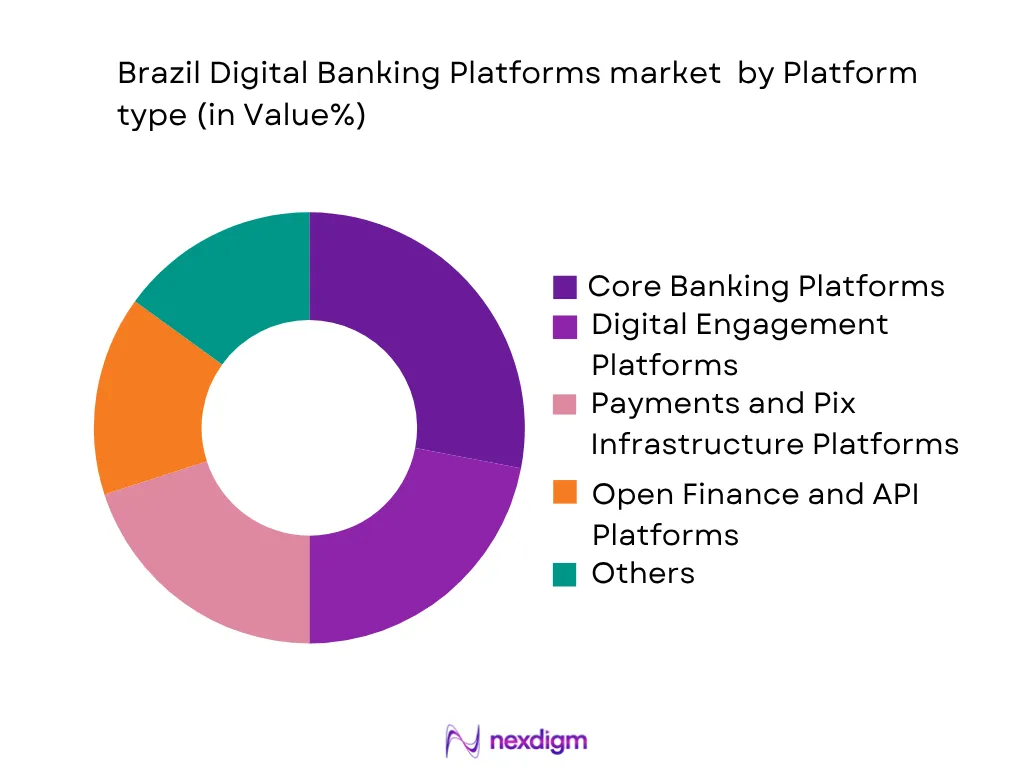
Brazil Digital Banking Platforms market is segmented by platform type into core banking platforms, digital engagement platforms, payments & Pix infrastructure platforms, Open Finance/API platforms, BaaS/embedded finance platforms, and onboarding & fraud platforms. Core banking platforms dominate the market due to the large-scale modernization initiatives undertaken by incumbent banks. Major institutions are replacing legacy systems with cloud-native cores to support real-time processing, scalability, and compliance with Pix and Open Finance frameworks. The need to handle millions of daily transactions and integrate multiple financial services has made core banking platforms central to digital transformation strategies.
By End-User Institution Type
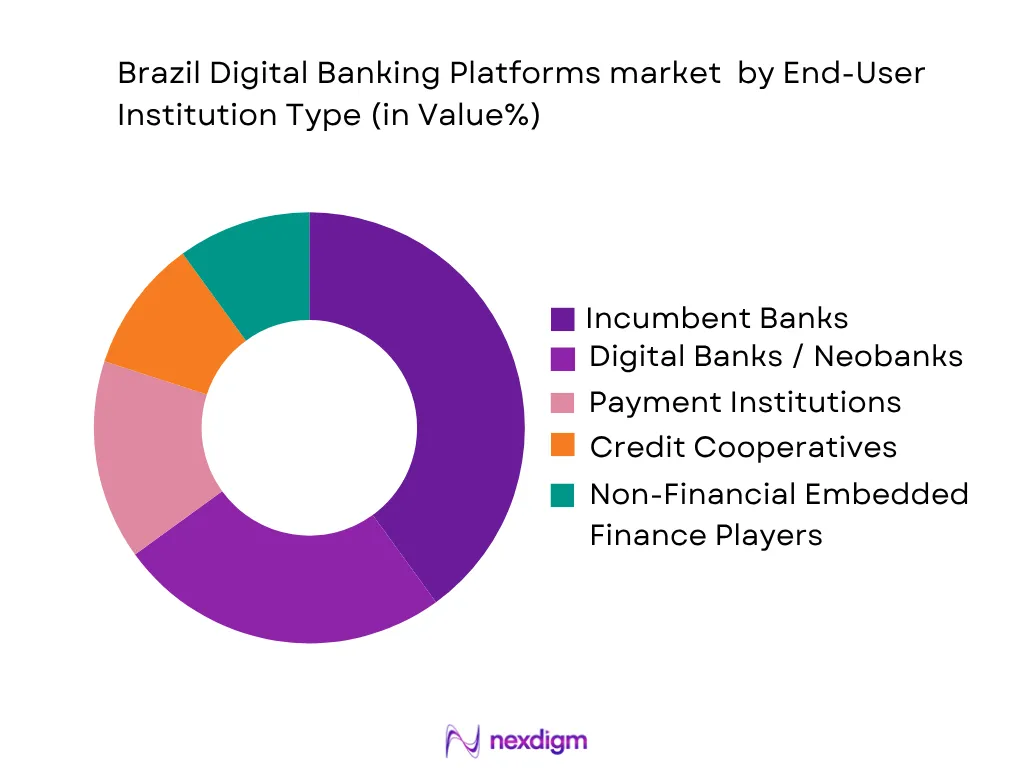
Brazil Digital Banking Platforms market is segmented by institution type into incumbent banks, digital banks/neobanks, payment institutions, credit cooperatives, and non-financial embedded finance players. Incumbent banks dominate the segment due to their large customer base, higher IT budgets, and ongoing investments in digital transformation. These banks are actively upgrading legacy systems, integrating Pix infrastructure, and deploying advanced analytics platforms. Their focus on omnichannel banking, customer experience, and regulatory compliance drives significant demand for digital banking platforms, maintaining their leadership position in the market.
Competitive Landscape
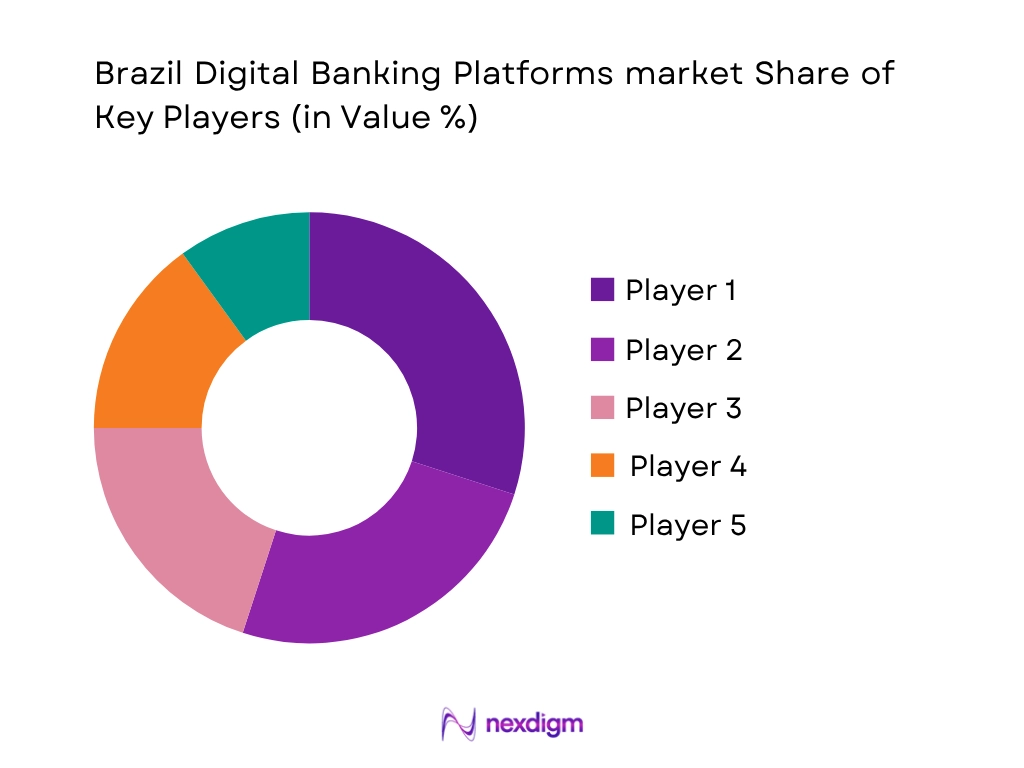
The Brazil Digital Banking Platforms market is dominated by a mix of local fintech infrastructure providers and global banking technology vendors. Local players such as Matera, Dock, and Pismo have strong dominance due to their deep integration with Pix and Open Finance frameworks. Global vendors like Temenos and Mambu are gaining traction through cloud-native offerings and partnerships with Brazilian financial institutions. This combination reflects a highly competitive yet innovation-driven ecosystem.
| Company | Establishment | Headquarters | Core Offering | Pix Integration | Open Finance Capability | Deployment Model | Target Clients | Revenue Model |
| Matera | 1987 | Brazil | – | – | – | – | – | – |
| Dock | 2018 | Brazil | – | – | – | – | – | – |
| Pismo | 2016 | Brazil | – | – | – | – | – | – |
| Temenos | 1993 | Switzerland | – | – | – | – | – | – |
| Mambu | 2011 | Germany | – | – | – | – | – | – |
Market Opportunity Analysis
Brazil’s digital banking platforms market presents a strong opportunity landscape driven by the convergence of real-time payments, Open Finance, and expanding digital access across consumers and businesses. The Central Bank reported R$22.12 trillion settled through Pix and over 800 participating institutions in Open Finance, while internet usage reached 168.0 million users and 74.9 million households in 2024, enabling scalable digital distribution. Total credit to the non-financial sector expanded to R$18.4 trillion, reflecting deeper financial intermediation across segments. These structural indicators highlight a clear opportunity for platform providers to deliver unified, API-driven banking architectures that enable embedded finance, SME lending, and data-led financial services. As financial institutions and non-banking entities increasingly require interoperable, real-time, and compliance-ready systems, the demand for modular digital banking platforms capable of supporting high transaction volumes and multi-channel engagement is expected to strengthen further.
Brazil Digital Banking Platforms Market Analysis
Growth Drivers
Pix-Led Real-Time Banking Experience Transformation
Brazil’s digital banking platform demand is being pulled upward by the scale of Pix and the system architecture required to support always-on, low-latency transactions. The Central Bank’s SPI Annual Report shows that the total value of transactions settled in 2024 reached R$22.12 trillion, while the SPI participant base rose to 863 institutions by December 2024, including 91 BCB-authorized payment institutions, 57 non-authorized payment institutions, and 577 credit unions. That volume is large enough to reshape core processing, fraud controls, treasury, and customer-experience design. The macro backdrop reinforces this: Brazil’s economy stood at US$2.64 trillion in current prices, while the annual unemployment rate fell to 6.6% and the real wage bill reached R$328.9 billion in 2024, supporting higher transaction intensity in everyday banking. For platform vendors, Pix is no longer a payment feature; it is the operating backbone forcing banks and fintechs to modernize orchestration, settlement connectivity, and fraud-response layers at scale.
Open Finance and Consent-Based Product Distribution Expansion
Open Finance is a structural growth engine because it turns data portability into a distribution rail for banking products, requiring institutions to invest in API management, consent architecture, security, and product orchestration. Official Central Bank material showed more than 42 million consents, more than 1.4 billion API calls per week, more than 68 billion cumulative API calls, and more than 800 participating institutions in 2024. By 2025, the ecosystem had moved to approximately 85 million active data-sharing consents and around 3.5 billion data-access requests per week, while payment initiations surpassed 3 million in recent months. This matters commercially because banks can no longer rely only on branch-led or app-led captive distribution; they need platforms that can consume, expose, and monetize customer-permissioned data across lending, cash management, insurance, and personal finance workflows. In a US$2.64 trillion economy with growing digital labor income and stronger household connectivity, consent-based banking materially expands the addressable opportunity for modular digital banking stacks.
Market Challenges
Integration Complexity with Legacy Core and Channel Systems
Integration remains one of the hardest barriers in Brazil because institutions must connect older core systems and channel stacks to multiple modern regulatory and payment rails simultaneously. By the end of 2024, SPI had 863 participants, Open Finance had more than 800 participating institutions, and the STR had 291 optional participants, while the Central Bank supervised 1,850 institutions overall. The Open Finance stack alone had 27 APIs developed and 12 under development in 2024, and STR access involved seven active PSTIs plus three already certified providers. That means banks often need to coordinate core vendors, channel vendors, middleware, payment rails, cybersecurity stacks, and regulatory APIs all at once. The problem is particularly acute for incumbents that still carry product silos across deposits, cards, loans, and collections. In practice, the modernization burden is not just code migration; it is systems orchestration across regulated infrastructure layers that continue to expand in scale and functionality.
High Total Cost of Migration, Customization, and Parallel Run
The cost challenge in Brazil is driven less by sticker price and more by the architecture required to keep old and new environments running in parallel while institutions preserve compliance and customer continuity. The STR report shows that 95% of participants used RSFN as their main access method in 2024, while 204 RSFN users relied on PSTIs, and among the 48 institutions that joined STR in 2024, 34 chose a PSTI model and 10 opted for direct access. This confirms that institutions often need intermediary technology layers even before they start wider core and channel migration. At the same time, total credit to the non-financial sector reached R$18.4 trillion in December 2024 and R$20.8 trillion in December 2025, so institutions cannot afford prolonged instability in transaction processing or risk controls. The higher the transaction load, the more expensive the parallel-run period becomes, because banks must maintain data consistency, reconciliation, fraud coverage, and customer-service continuity across legacy and modern platforms simultaneously.
Market Opportunities
SME-Focused Digital Banking Platforms with Cashflow and Credit Intelligence
A major opportunity lies in SME-focused platforms because Brazil’s economic base combines strong digital adoption with a large pool of workers and businesses that need simpler access to cash-flow visibility, payments, collections, and credit. In 2024, Brazil had 26.1 million self-employed workers, 47.7 million formal jobs by November, 74.9 million households with internet access, and 168.0 million internet users, while total credit to the non-financial sector reached R$18.4 trillion in December 2024 and R$21.0 trillion by February 2026. Those numbers support demand for platforms that unify transaction data, receivables intelligence, merchant collections, and risk scoring for smaller businesses. The opportunity is not only to digitize current accounts; it is to create decisioning engines that turn Pix inflows, account activity, and recurring payment behavior into working-capital and cross-sell propositions. As banking moves further into app-led and API-led distribution, vendors that solve SME cash-flow visibility and embedded credit orchestration can capture a meaningful growth runway without relying on headline consumer banking alone.
Cooperative and Regional Institution Modernization Opportunity
Cooperative and regional institutions represent one of the clearest growth opportunities because they combine deep local reach with rising digital and regulatory demands that increasingly require industrial-grade platforms. As of December 2024, SPI included 577 credit unions, and the Central Bank notes that the large number of optional participants using indirect access is largely explained by individual credit unions connecting through central cooperatives or cooperative banks. Another official BCB publication states that credit unions reached 58% of municipalities in December 2024, had 19.2 million members, and accumulated R$885.3 billion in assets by 2025. These figures matter because cooperative institutions often serve areas less covered by traditional banking networks, making them an important channel for financial inclusion and regional market expansion. Their next phase of growth requires stronger core modernization, unified digital channels, scalable Pix connectivity, fraud and compliance automation, and better member-level analytics. For platform vendors, this is a high-potential segment because modernization demand is real, the distribution footprint is wide, and the institutions are already integrated into national payment and financial infrastructure.
Future Outlook
The Brazil digital banking platforms market is expected to witness strong growth driven by the expansion of Pix, Open Finance, and embedded finance ecosystems. Increasing demand for real-time processing, AI-enabled banking services, and cloud-native architectures will further accelerate platform adoption. Financial institutions are expected to prioritize scalability, interoperability, and compliance, leading to continuous innovation in platform capabilities.
Major Players
- Matera
- Dock
- Pismo
- Topaz
- Celcoin
- QI Tech
- FitBank
- Zoop
- Temenos
- Backbase
- Mambu
- Thought Machine
- Finastra
- Oracle Financial Services
- Infosys Finacle
Key Target Audience
- Retail and Universal Banks (Itaú Unibanco, Banco do Brasil, Bradesco)
- Digital Banks and Neobanks (Nubank, Banco Inter, C6 Bank)
- Payment Institutions and PSPs (StoneCo, PagSeguro)
- Credit Cooperatives (Sicredi, Sicoob)
- Fintech Infrastructure and BaaS Providers
- Investments and Venture Capitalist Firms
- Government and Regulatory Bodies (Central Bank of Brazil, CVM)
- Large Enterprises Exploring Embedded Finance
Research Methodology
Step 1: Identification of Key Variables
The study begins with mapping the digital banking ecosystem in Brazil, including banks, fintechs, payment institutions, and platform vendors. Secondary research sources such as central bank publications, financial reports, and fintech databases are used to identify key demand and supply-side variables influencing platform adoption.
Step 2: Market Analysis and Construction
Historical data is compiled on digital transactions, Pix volumes, IT spending, and platform deployments. This data is analyzed to construct market size and segmentation, ensuring alignment with real-world financial activity and platform usage trends across institutions.
Step 3: Hypothesis Validation and Expert Consultation
Insights are validated through expert interviews with banking professionals, fintech founders, and technology vendors. These discussions help refine assumptions related to adoption patterns, pricing models, and competitive positioning within the market.
Step 4: Research Synthesis and Final Output
All collected data is synthesized into a structured analysis combining quantitative metrics and qualitative insights. The final report integrates segmentation, competitive benchmarking, and future outlook to provide a comprehensive view of the Brazil digital banking platforms market.

- Executive Summary
- Research Methodology (Market definitions and platform boundary, abbreviations, benchmarking framework, market sizing approach, competitive intelligence model, demand-side interview approach, pricing triangulation methodology, implementation mapping framework, limitations and assumptions)

- Definition and Scope
- Evolution of Brazil’s Digital Banking Stack
- Market Genesis Through Pix, Open Finance, and Embedded Finance
- Digital Banking Value Chain and Platform Architecture
- Ecosystem Mapping of Banks, Digital Banks, Payment Institutions, BaaS Players, and Enablers
- Role of Central Bank Infrastructure in Platform Adoption
- Buyer Journey for Digital Banking Platform Selection
- Brazil Platform Business Cycle and Monetization Evolution

- Growth Drivers
Pix-Led Real-Time Banking Experience Transformation
Open Finance and Consent-Based Product Distribution Expansion
Legacy Core Replacement and Progressive Modernization Demand
Embedded Finance and White-Label Banking Expansion Across Commerce and Services
Demand for Unified Retail, SME, and Payments Journeys
Fraud, Risk, and Compliance Automation as Core Buying Trigger - Market Challenges
Integration Complexity with Legacy Core and Channel Systems
High Total Cost of Migration, Customization, and Parallel Run
Fraud, Account Takeover, and Pix Abuse Risks
Compliance Burden Across LGPD, AML, KYC, and Central Bank Requirements
Multi-Vendor Stack Fragmentation and Orchestration Challenges
Difficulty Proving ROI Beyond Front-End Digitization - Market Opportunities
SME-Focused Digital Banking Platforms with Cashflow and Credit Intelligence
Cooperative and Regional Institution Modernization Opportunity
AI-Powered Personalization, Financial Guidance, and Service Automation
Open Finance-Powered Product Comparison and Marketplace Models
Embedded Finance for Retail, Mobility, Agribusiness, and SaaS Ecosystems
Drex / Tokenization Readiness as a Future Platform Differentiator - Key Trends
Composable Banking and Progressive Core Renewal
Pix Automático and Recurring Payment Enablement
API-First Open Finance and Consent-Layer Productization
Retail-to-SME Super-App Convergence
Direct Pix Participation as a Strategic Capability
Shift from Single-Module Vendors to Multi-Layer Platform Providers - Regulatory and Compliance Landscape
Central Bank Infrastructure and Participation Requirements
Open Finance Governance, Consent, and Data Portability Rules
Payment Institution and Electronic Money Issuer Requirements
Credit Fintech Structures: SCD and SEP Relevance
LGPD and Data Governance Implications for Platform Design
AML, Fraud Prevention, and Transaction Monitoring Imperatives - Value Chain Analysis (core providers, digital layer vendors, payment rails, KYC/fraud vendors, cloud partners, integrators, regulated institutions)
- Stakeholder Ecosystem (banks, digital banks, fintechs, PSPs, cooperatives, merchants, regulators, cloud providers, system integrators)
- Porter’s Five Forces (entry barriers, supplier power, buyer power, substitution threats, platform rivalry)
- Opportunity White Space Mapping (underserved institution cohorts, module gaps, regional whitespace, use-case whitespace, partnership whitespace)

- By Revenue, 2020-2025
- By Software vs Services Spend, 2020-2025
- By Number of Institutions Served, 2020-2025
- By Deployment Model, 2020-2025
- By Platform Layer, 2020-2025

- By Platform Layer (In Value %)
Engagement Banking / Omnichannel Experience Platforms
Core Banking Platforms
Payments, Pix, and Account Infrastructure Platforms
Open Finance / API / Consent Management Platforms
Banking-as-a-Service / Embedded Finance Platforms
Digital Onboarding, KYC, Fraud, and AML Orchestration Platforms - By Deployment Model (In Value %)
Cloud-Native SaaS
Private Cloud / Hosted
Hybrid Deployment
On-Premise Modernized Stack - By Institution Type Served (In Value %)
Incumbent Universal and Retail Banks
Digital Banks / Neobanks
Payment Institutions / Electronic Money Issuers
Credit Cooperatives and Cooperative Banking Networks
Finance Companies / Digital Lenders / SCD-SEP Structures
Non-Financial Brands Launching Embedded Finance Offerings - By Primary Use Case (In Value %)
Retail Banking and Daily Banking Journeys
SME Banking and Cash Management
Cards, Wallets, and Account Issuance
Digital Lending and Origination
Collections, Billing, and Merchant Settlement
Personal Financial Management / Super-App Financial Layer - By Commercial Model (In Value %)
License-Based Enterprise Platform
Subscription / SaaS Model
Transaction-Based / Usage-Based Model
Managed Service / BPaaS Model
Revenue-Share / White-Label Platform Model - By Region (In Value %)
Southeast Brazil
South Brazil
Northeast Brazil
Midwest Brazil
North Brazil

- Competitive Positioning Matrix [Platform breadth vs specialization, Brazil-native vs global vendor positioning, full-stack vs modular offerings, target customer segments]
- Vendor Strategy Mapping [Go-to-market models, partner-led vs direct sales, vertical specialization, SME vs enterprise focus, embedded finance targeting]
- Innovation Benchmarking [Pix feature innovation, Open Finance API capabilities, AI/ML integration in banking journeys, fraud prevention technologies, product release velocity]
- Platform Capability Benchmarking [Core banking flexibility, API-first architecture maturity, scalability, latency performance, real-time processing capability, composability index]
- Ecosystem Strength Analysis [Cloud partnerships, fintech integrations, marketplace ecosystems, system integrator alliances, regulatory engagement]
- Localization and Regulatory Fit Analysis [Pix integration depth, Open Finance compliance readiness, LGPD alignment, Central Bank interoperability adherence]
- Customer Penetration and Use-Case Mapping [Client base by institution type, use-case concentration, SME vs retail adoption, embedded finance deployments]
- Pricing and Commercial Strategy Intelligence [Subscription vs transaction-based pricing, revenue-sharing models, bundling strategies, implementation cost positioning]
- M&A, Partnerships, and Expansion Strategies [Recent acquisitions, strategic alliances, geographic expansion focus, product portfolio expansion]
- Competitive Risk Assessment [Vendor lock-in risk, dependency on infrastructure partners, regulatory exposure, scalability limitations, pricing pressure dynamics]

- Competitive Landscape and Market Positioning (core-centric vendors, engagement-layer vendors, Pix/Open Finance specialists, BaaS players, modular challengers)
- Market Share of Major Players (by deployment base, by institution type served, by platform layer, by recurring client relevance)
- Cross Comparison Parameters (Pix and real-time payments readiness, Open Finance and API/consent capability, core modernization depth, BaaS/embedded finance enablement, fraud/risk/compliance stack, deployment flexibility and cloud maturity, pricing/commercial flexibility, local implementation and support ecosystem)
- SWOT Analysis of Major Players (platform breadth, localization strength, integration agility, regulatory fit, commercial scalability, ecosystem leverage)
- Pricing Analysis (digital account stack, core ledger, Pix processing, Open Finance layer, onboarding/KYC, fraud controls, implementation services, managed services)
- Implementation Benchmarking (time-to-launch, migration complexity, modular deployment, partner ecosystem, local delivery model, product extensibility)
- Detailed Profiles of Major Companies
Matera
Dock
Pismo
Topaz
Celcoin
QI Tech
FitBank
Zoop
Temenos
Backbase
Mambu
Thought Machine
Finastra
Oracle Financial Services
Infosys Finacle

- Demand by Institution Type (incumbents, neobanks, PSPs, cooperatives, lenders, embedded finance brands)
- Buying Parameters (time-to-market, Pix readiness, Open Finance compliance, scalability, API maturity, TCO, localization, partner support)
- Needs, Pain Points, and Unmet Gaps (channel orchestration, core agility, fraud control, interoperability, product launch speed, data unification)
- Budget Allocation and Transformation Priorities (front-end renewal, core renewal, payments modernization, compliance stack, analytics and AI)
- Decision-Making Unit Analysis (business sponsor, CIO/CTO, payments head, risk/compliance, architecture office, procurement)
- Platform Selection Journey (RFI/RFP triggers, pilot strategy, systems integrator role, migration risk filters, commercial negotiation patterns)
- Implementation Preferences (greenfield launch, sidecar core, phased migration, API wrapper model, managed service adoption)

- By Revenue, 2026-2035
- By Software vs Services Spend, 2026-2035
- By Number of Institutions Served, 2026-2035
- By Deployment Model, 2026-2035
- By Platform Layer, 2026-2035

- TAM Expansion Drivers [Increase in Pix transaction volumes, Open Finance adoption scaling, embedded finance penetration, SME digitization demand]
- Segment-Wise Opportunity Mapping [Neobanks, cooperatives, payment institutions, SME-focused platforms, non-financial embedded finance players]
- Use-Case Opportunity Analysis [Instant payments innovation, lending-as-a-service, financial super-app ecosystems, cross-border payments, recurring payments (Pix Automático)]
- Regional Opportunity Hotspots [Southeast saturation vs Northeast and Midwest growth potential, financial inclusion zones, underserved banking regions]
- Product Innovation White Spaces [AI-driven financial advisory, real-time credit decisioning, consent-based product marketplaces, programmable banking features]
- Embedded Finance Expansion Opportunities [Retail, mobility, agribusiness, e-commerce, SaaS platforms, telecom-led financial services]
- Open Finance Monetization Opportunities [Data-driven lending, cross-selling, account aggregation services, personalized financial journeys]
- SME and Informal Economy Digitization Opportunities [Micro-merchant onboarding, working capital financing, digital collections, POS-linked financial services]
- Partnership and Ecosystem Opportunities [Bank-fintech collaboration, BaaS partnerships, cloud-provider alliances, API marketplace expansion]
- Investment and Entry Strategy Opportunities [Greenfield vs partnership entry, acquisition targets, niche platform entry, regulatory sandbox participation]


 Request a Sample
 Ask for Customization
 Get a Quote
 Enquire Now